


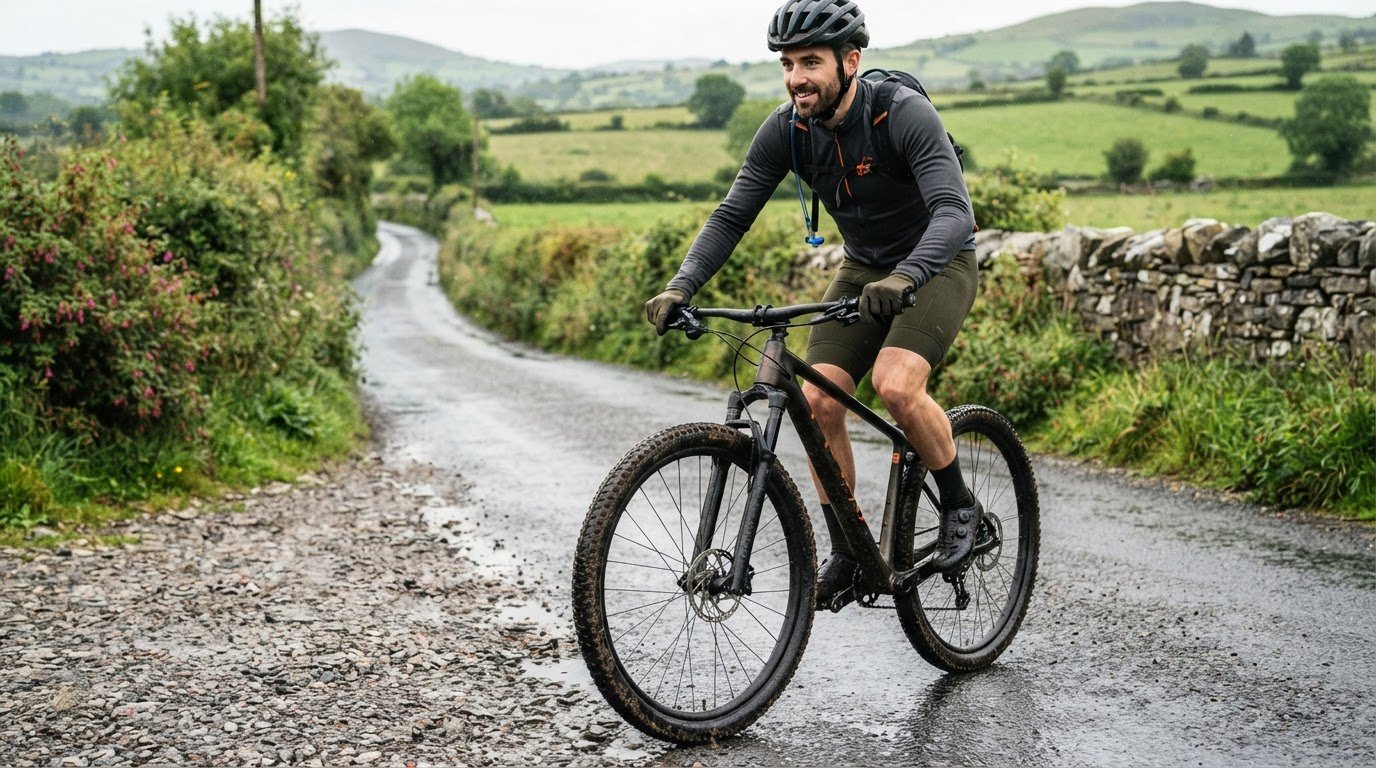
A mountain bike can be ridden on public roads without damaging it simply because it’s used on tarmac. So, can you use a mountain bike on the road? Yes, although its wider, treaded tyres and off-road gearing usually make it slower and less efficient than a road bike on smooth surfaces.
That extra grip and cushioning can be useful when your ride includes rough lanes, gravel paths or trails. The trade-off is greater rolling resistance on tarmac, so you may need to pedal harder to maintain your pace.
This guide explains how mountain bikes handle roads, how tyre width and tread affect speed, and why tyre pressure matters. You’ll also learn when a mountain bike suits a journey across smooth roads and uneven terrain, and when another type of bike may be a better fit.
Key Takeaways
- A mountain bike can handle public roads, but its geometry and upright riding position feel different from a road bike.
- Wider, knobbier tyres add grip on rough ground, whilst their tread and width can make tarmac riding take more effort.
- Tyre choice and pressure affect the balance between rolling resistance on roads and grip on uneven surfaces.
- Consider where you ride most: a mountain bike suits mixed routes with trails, gravel or rough ground, but is less efficient on smooth roads.
- If a regular commute is part of your plans, explore the Bike to work option alongside the range of Electric Mountain Bikes.
Riding mountain bike works better on roads?
In Ireland, you can ride a mountain bike on public roads, but its design is better suited to rough ground than smooth tarmac. On roads, wide handlebars can feel awkward in heavy traffic, and frequent pavement riding can contribute to wear.
Upright Geometry and Riding Position
Mountain-bike geometry brings the handlebars closer to the rider, with a shorter reach and top tube than a road bike. This creates a more upright riding position, helping you steer steadily and climb hills at a controlled pace. Flat handlebars are easy to hold, whilst wider bars offer control on trails. In heavy Irish traffic, though, that width can feel less comfortable when passing close to vehicles.
Choosing Between Paved and Off-Road Riding
Choose a bike by matching its frame, tyres and suspension to the surfaces you ride most. A mountain bike suits muddy singletrack, rocky trails and gravel paths, where suspension helps absorb bumps. For a commute across smooth roads and uneven lanes, a hybrid can be a middle ground: it has thicker tyres than a standard road bike but is less capable on rugged ground.
Adapting a Mountain Bike for Road Riding
You can adapt a mountain bike’s setup to make regular tarmac journeys more comfortable and efficient. For ordinary roads, medium-sized road tyres are a practical option; higher pressure suits asphalt, while lower pressure provides more grip. Keep your route in mind: tyres that roll more easily on pavement may offer less traction on trails. Full mudguards can also be difficult to fit, particularly with a suspension fork.
A mountain bike doesn’t become unsuitable simply because you ride it on tarmac. However, regular road riding can cause wear and tear, so commuting every day may mean more maintenance. The low gearing helps on steep hills but is intended for slower, technical riding. On flat roads, you may need to pedal more to maintain pace than you would with road-bike gearing.
Suspension changes how the bike responds to Ireland’s rougher lanes and broken surfaces. A hardtail has front suspension only, whilst a full-suspension bike has both front and rear suspension. That cushioning can help on rough tracks, but suspension is less useful on smooth pavement. If your route includes gravel sections or trails, the comfort may justify the compromise; for a mainly paved commute, consider how often you’ll use it.
Consider your route before changing the bike. A short trip on smooth streets calls for a different setup from a ride combining tarmac, gravel and muddy tracks. Mountain-bike saddles generally offer more cushioning than road-bike saddles, and the upright position can make hill climbing feel more manageable. For either type of riding, wear suitable cycling clothes, a helmet and gloves.
Avoid cycling on pavements, where a bicycle can put pedestrians at risk. Use the road or a cycle lane instead, and take care in traffic, particularly where wide handlebars leave less room to manoeuvre. For a journey that switches between city streets and rough trails, a mountain bike can be versatile; for frequent smooth-road riding, its off-road setup may feel less efficient.
Differences between mountain-bike and road-bike tyres
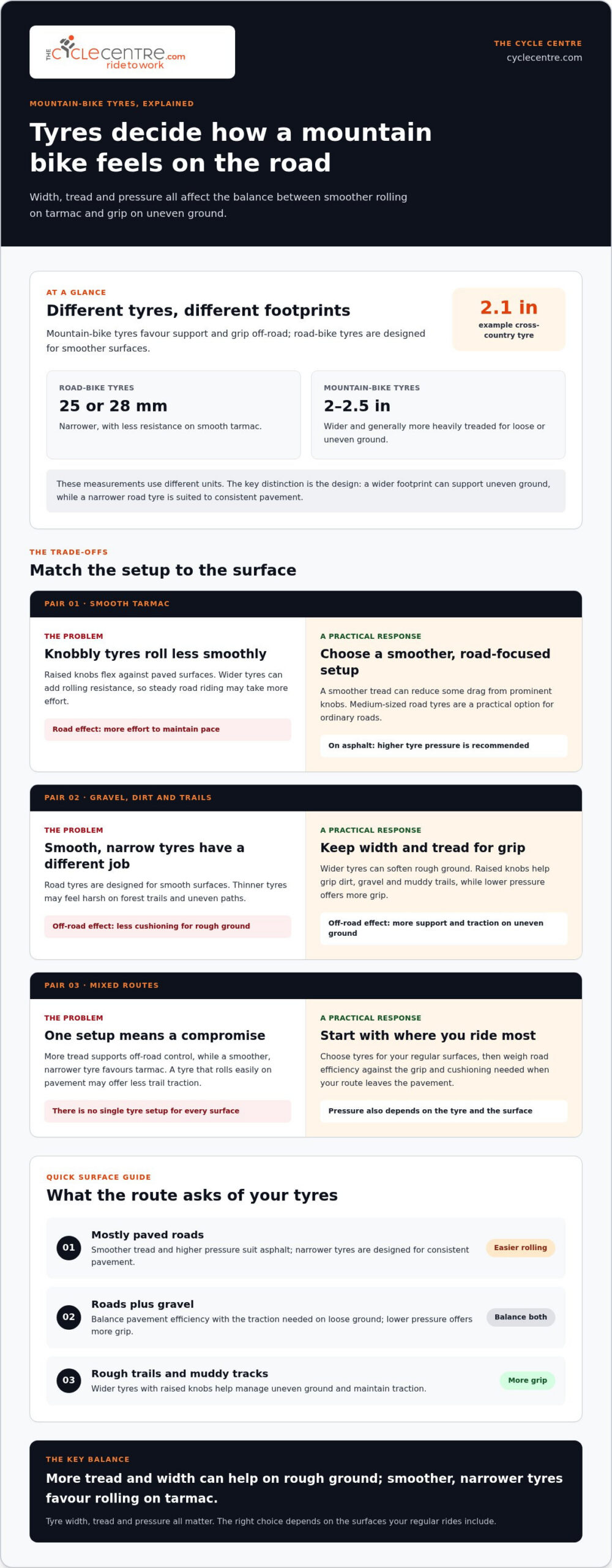
Tyres are one of the clearest differences between mountain bikes and road bikes. Mountain-bike tyres are generally wider, more durable and more heavily treaded, while road-bike tyres are narrower and designed for smoother surfaces. These differences affect grip, comfort and the effort needed to keep a bike moving on everyday rides.
Many road bikes use tyres measuring 25 or 28 mm wide. Mountain-bike tyres are usually between 2 and 2.5 inches wide, with a 2.1-inch tyre offering one example of a cross-country setup. These measurements describe very different footprints. A wider tyre can provide more support on loose or uneven ground, whilst a narrower road tyre meets less resistance on smooth tarmac.
Tread matters as much as width. Raised knobs on mountain-bike tyres can grip dirt, gravel and muddy trails, helping maintain traction on shifting ground. On paved roads, those knobs flex against the surface instead of rolling as smoothly as a road tyre. As a result, steady road riding can feel less efficient.
Choose tyres based on where you ride most. Mountain-bike tyres suit rocky tracks and rough trails, where their wider profile and tread help manage uneven ground. Narrow road tyres are better suited to consistent pavement. The compromise is clear on mixed routes: more tread supports off-road control, while a smoother, narrower tyre favours tarmac.
That trade-off affects comfort as well as speed. Wider tyres can soften the feel of rough ground, while thinner tyres may feel harsh on forest trails and uneven paths. Conversely, tyres that are too thick can make descents harder, particularly when quick changes of direction are needed. The best fit matches the surfaces and handling demands of your regular rides.
If you mainly ride a mountain bike on roads, a smoother tread can reduce some of the drag caused by prominent knobs. It won’t necessarily roll like a road-bike tyre, because width also affects resistance. Tyre width can also affect rolling resistance, even when the tread is smooth. Weigh road efficiency against the grip and cushioning you need when your route leaves the pavement.
Tyre pressure also affects how a tyre behaves, but the suitable level depends on the tyre and surface. Higher pressure is recommended on asphalt, while lower pressure offers more grip. On a route combining smooth streets and gravel, you’re balancing easier rolling against traction on loose ground. Tyre width and tread matter too, not just appearance.
For frequent paved rides, consider whether a road-focused bicycle better matches your usual route. A road performance bicycle is designed for that riding style, while mountain-bike tyres make more sense when trails and rough surfaces are part of the plan. Choose for the ground you ride most, then consider how much off-road grip you’re willing to trade for smoother rolling.
Mountain bike speed and rolling resistance on tarmac
Can you use a mountain bike on the road and keep a comfortable pace? Yes, though smooth tarmac usually takes more effort than it would on a road bike. Wide tyres, prominent tread and a heavier frame can all slow progress. The difference is most noticeable on flat stretches, where off-road grip offers little advantage. Your pace also depends on the route, your effort and the bike’s setup.
Rolling resistance is the energy a tyre loses as it deforms against the ground. A wide mountain-bike tyre can flex more under the rider, while its tread moves against the road. Both effects can make steady pedalling feel harder. On loose trails, that construction helps the tyre grip; on smooth pavement, the same features can reduce efficiency. Tyre pressure, rider load and road condition also affect how freely the bike rolls.
Gearing changes how you manage that effort. Mountain bikes have low gears for slow, technical riding and steep climbs, which can make hills easier to tackle. They don’t remove the resistance created by wide tyres on level roads. Road-bike gearing is generally better suited to maintaining momentum on smooth tarmac. Your cadence and gear choice affect the ride, even on flat terrain.
Pressure affects how much a tyre deforms as it rolls. Higher pressure is recommended for asphalt, while lower pressure offers more grip on uneven ground. On a paved commute, firmer tyres can reduce casing movement. If your route includes rough sections, some give can help maintain grip. The right balance depends on the tyre and route, so one pressure won’t suit every mountain bike.
Individual examples need context. One rider reported that switching to 28 mm slick tyres solved their rolling-resistance problem. That experience doesn’t establish a universal fit for mountain-bike wheels. A city rider reported a front tyre measuring 45 watts in rolling tests, whilst another rider used 27 PSI. These figures describe particular setups; they don’t predict every rider’s speed or effort on Irish roads.
Comfort and control also shape the ride. An upright position and wide handlebars may feel comfortable at a relaxed pace, but the bars can be less manageable in heavy traffic. A hybrid can suit a route mixing paved streets and uneven paths, though it’s less suited to rugged terrain. Consider the whole journey, including tight turns, road crossings and the surfaces you’ll encounter.
So, can you use a mountain bike on the road for a regular commute? Yes, but expect its off-road setup to take more effort on pavement. Smoother tread may help, although a wide slick tyre can still create more rolling resistance than a road tyre. Try the bike on your usual route, including hills and stops, before deciding whether its versatility suits your everyday rides.
Mountain bikes as all-round bikes for different surfaces
A mountain bike can handle several surfaces on one ride, from paved streets to gravel paths and rocky singletrack. Its tyres and suspension help on uneven ground, where a road-focused setup may feel less composed. The trade-off is that those same off-road features can make long stretches of smooth tarmac less efficient. Think about your actual route, not simply whether it includes a road.
For a route between pavement and loose gravel, a mountain bike offers traction and cushioning as conditions change. On muddy tracks, tread helps the tyres grip; over stones and ruts, suspension absorbs impacts. On a smooth ride through town, those features offer less benefit. If you spend most of your time on pavement, the off-road capability may add unnecessary weight and resistance.
Suspension design helps explain where different mountain bikes feel at home. A hardtail has front suspension only, whilst a full-suspension bike has front and rear suspension. Hardtail front travel ranges from 100 to 140 mm; full-suspension travel ranges from 100 to 200 mm. More travel is intended for absorbing bigger impacts, so a rough rocky descent demands something different from a mainly paved commute.
Imagine a ride that starts on a road, continues along a gravel path, then follows a muddy trail. A mountain bike can handle that sequence without changing bikes, and its suspension and tyres help on rough sections. However, the road stretch may take more effort than it would on a road bike. A hybrid can suit commuting and uneven paths, but it’s less suited to very rugged terrain.
Brakes matter too as surfaces and descents change. Hydraulic disc brakes can cool faster than cable brakes, helping prevent brake fade on long, demanding descents. That distinction matters more on a sustained downhill trail than on a flat paved journey. Braking performance still depends on the bike’s setup and condition, so choose a bike and equipment suited to the terrain.
Not every mountain bike is equally suited to regular road use. A model designed for rugged trails may feel cumbersome on smooth streets, while a less specialised setup can adapt better to gravel and pavement. Look at the whole route: repeated road sections favour efficient rolling, while rocky paths and muddy singletrack reward grip and impact absorption. Let the surface that presents the greatest handling challenge guide your choice.
Mountain bikes work best as all-rounders when a ride genuinely includes off-road ground. For example, someone travelling between paved streets and a rough gravel track may value stability and cushioning more than maximum road efficiency. A ride made up almost entirely of smooth tarmac calls for a different balance. No single setup suits every surface, so choose according to where you ride most often.
Electric assistance changes the effort involved, not the terrain a bike is designed to handle. An electric mountain bike can support rides combining roads and rough trails, but its tyres and suspension still shape how it behaves on each surface. Match the bike to the roughest sections you plan to ride, then consider whether it handles the rest of your journey comfortably.
The Cycle Centre: Bike to work
The Cycle Centre can help you find a bike that suits your commute and the surfaces you ride. If your route includes rough paths as well as roads, its Electric Mountain Bikes may suit your needs; for a regular work journey, explore the Bike to work option. Your best fit depends on where you ride most and whether off-road capability matters more than efficient travel on smooth tarmac.
Use the points in this guide to weigh tyre type, terrain and comfort before deciding. A mountain bike can handle road journeys, but a commute dominated by smooth pavement may call for a different balance of features. Explore the options that suit your route and routine.
Contact The Cycle Centre or visit cyclecentre.com to discuss your next ride.
Choose the bike that fits your next ride
Picture an ordinary week of cycling, not just one ideal route. Consider where you’ll ride, how often you’ll leave paved streets and what matters most on the journey. If you’re still deciding whether you can use a mountain bike on the road, weigh that choice against the comfort and efficiency you want from everyday rides.
The Cycle Centre offers Bike to work, Cycle to work and Ride to work options for people considering a bike for their commute. These schemes can be a useful starting point when matching your daily journey with the right kind of riding. A clear idea of your route makes it easier to choose a suitable option.
Contact The Cycle Centre for advice and take the next step towards choosing a bike that gets you out riding with confidence.
Frequently Asked Questions
Road vs Mountain Bikes: Which Should You Choose?
Choose a road bike for routes dominated by smooth pavement and a mountain bike for frequent off-road riding. A journey combining town streets with muddy tracks calls for different qualities from a commute on continuous tarmac. If your route varies, consider how much time you spend on each surface and whether speed, comfort or trail control matters most. A hybrid can suit mixed commuting and uneven paths.
Can you legally ride a mountain bike on public roads in Ireland?
Yes, you can ride a conventional mountain bike on public roads in Ireland. Its off-road design doesn’t prevent road use. Ride attentively around traffic and pedestrians, using cycle lanes or the road rather than pavements. In busy areas, leave extra room for wide handlebars and choose a position that lets you see and respond to surrounding traffic.
Are mountain bikes safe and practical for road riding?
Yes, a mountain bike can be practical for road journeys, particularly when your route also includes rough lanes or gravel. Its upright position can help you see ahead, while suspension can smooth uneven sections. On a narrow, busy street, wide handlebars may make positioning more demanding. Wear a helmet and gloves, and make sure the bike responds predictably before taking a route with heavy traffic or frequent stops.
How much slower is a mountain bike on roads than a road bike?
There’s no single speed difference that applies to every rider or route. On flat tarmac, wide tyres, knobbly tread, a heavier frame and off-road gearing can all increase effort compared with a road bike. A smoother tyre may reduce tread-related drag, but width still affects rolling resistance. Hills, wind, surface condition and rider effort also affect pace, so compare bikes on the same route.
How can you make a mountain bike faster and more comfortable on roads?
Start by matching the setup to the amount of pavement you ride. Smoother tyres can reduce the drag of prominent tread, and suitable pressure helps them roll on asphalt. Check that the saddle and handlebars let you maintain a relaxed, controlled position; discomfort can make a commute harder to sustain. If you regularly carry items, consider their effect on handling. Keep the bike’s off-road grip in mind if your route includes trails.
What tyre pressure and tyres are best for riding a mountain bike on roads?
For asphalt, higher pressure is recommended, while lower pressure offers more grip on uneven ground. Choose smoother, medium-sized road tyres for ordinary paved routes, provided they fit the bicycle’s rims and frame. Follow the tyre maker’s pressure guidance for your particular tyre, and account for the rider and load. Avoid choosing pressure from a single example online: a setting that suits one tyre may not suit another.